
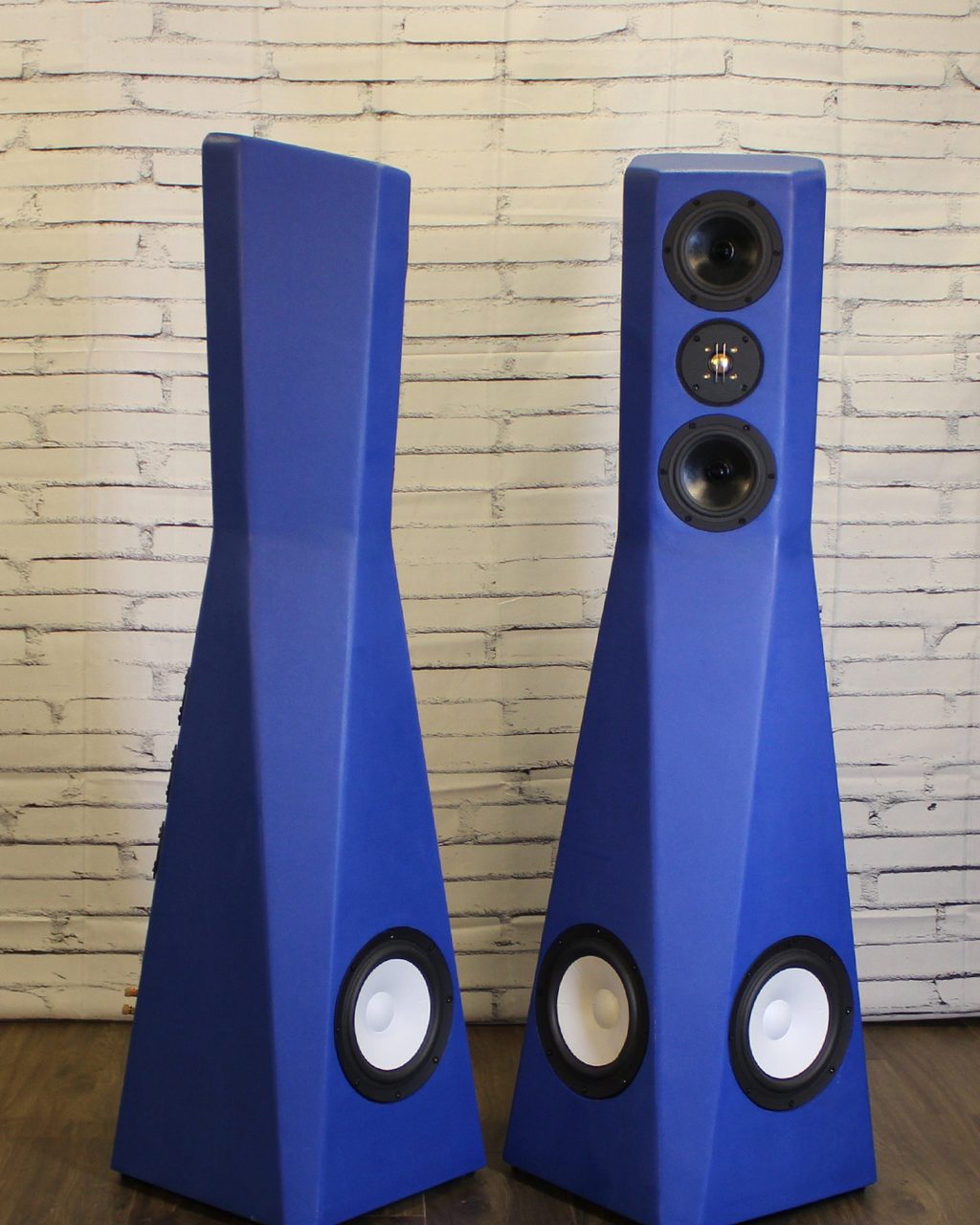
Bella Sonus Azzurre #22
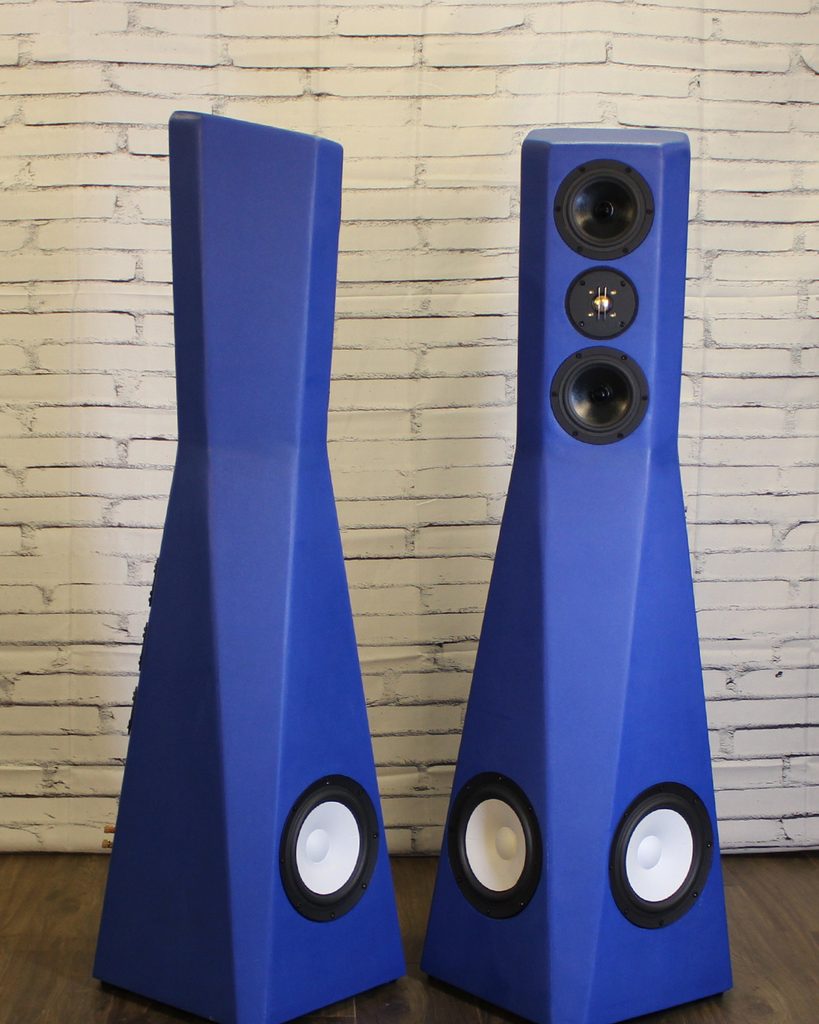
“I believe this my best work as my most unique great sounding speaker.”
“Bella Sonus Azzurre #22” Tower Speakers, by Michael C Hadjinian
Project Level: Advanced
Project Time: 20+ Hours
Project Cost: Over $1,000
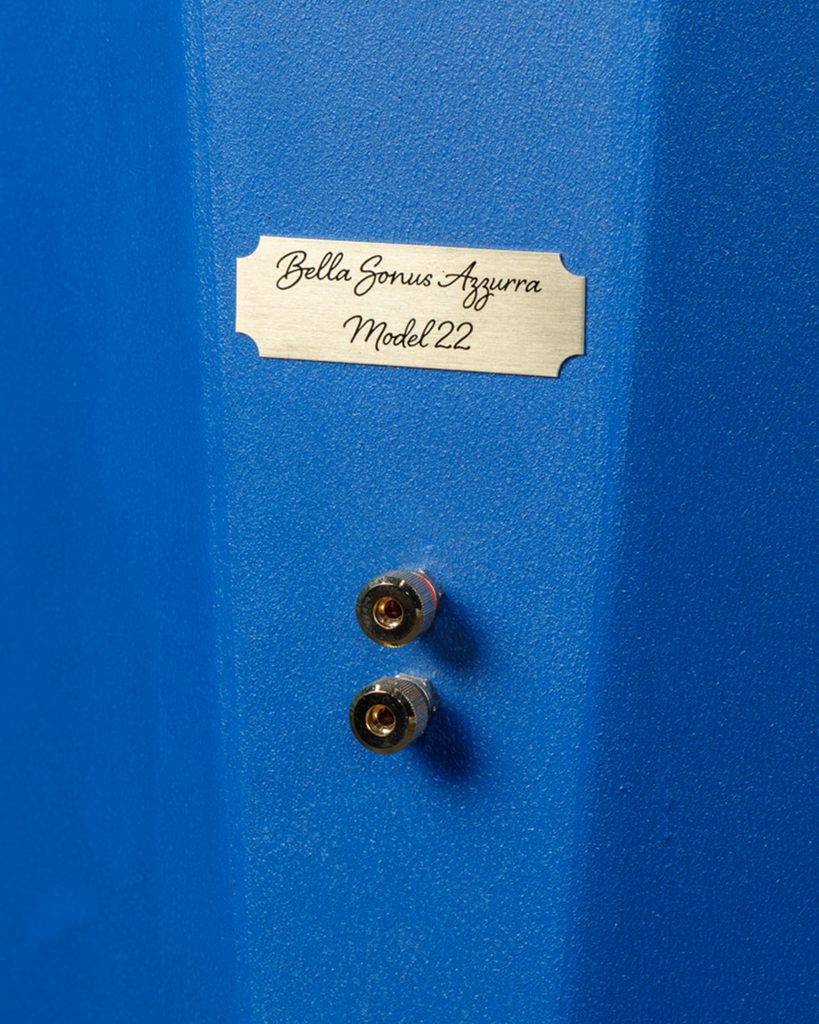
Project Description: I named my project Bella Sonus Azzurra Model #22 (Bella is Italian for beautiful, Sonus is Latin for sound and Azzurra is Italian for azure or blue.)
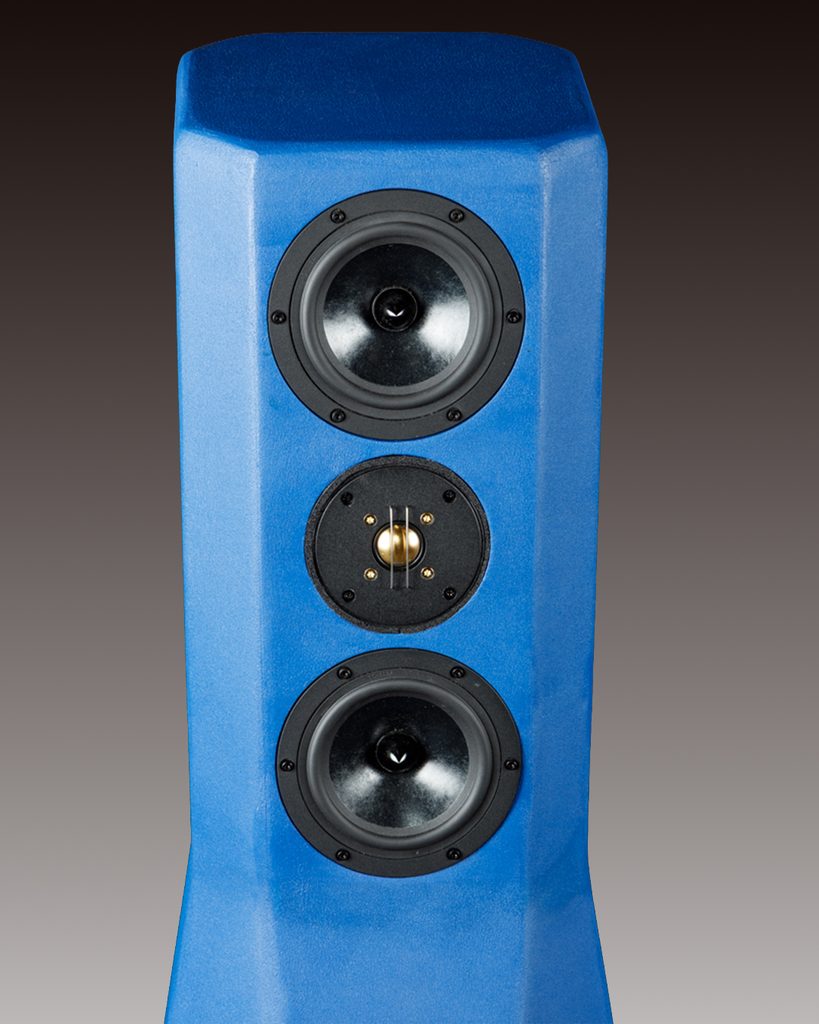
It is a 3-way speaker with an MTM cabinet above a large woofer cabinet below.
This design is a new direction for me. I believe it is unique in the DIY world.
Design Goals: You probably are wondering where this shape came from. I challenged myself that a step in my evolution in the hobby was to build a speaker that is a statement – I want it to be a form of art or sculpture that over-powers the room. Instead of blending in it is meant to dominate the room as the center of attention.
The design is shocking at first but then it grows on you. For example, notice that the top is larger than the waist. I find it very interesting to look at from different angles. It immediately gets your attention. I want lots of emotion. The emotion I seek is to feel that it is awesome, cool, and asks the question: what is that? I don’t know but I like it!
There are two high end commercial speakers that serve as examples of this emotion to me and provide inspiration: YG Acoustics Sonja 3 and the Estelon Forza. The YG Sonja 3 is made of polished aluminum and is shaped artistically with a gentle floor to top taper on a traditional 4-sided pyramidal shape. It relaxes you. The Estelon Forza is made of composite material and has gentle curves and smoothness – it is pleasant to look at, like a sculpture. It is so interesting, you can’t figure it out, the shape from every angle seems different, it seems like it is alive.
These are both high-end, awesome products that sound and look expensive. My objective was not to copy them but to build upon their emotional inspiration with my own unique design that evokes same emotions of wonder and attractiveness.
Enclosure Design: The physical design is a heavy into 3D geometry. My original educational background is engineering and this was a design problem that required me to fully exercise my spatial imagination.
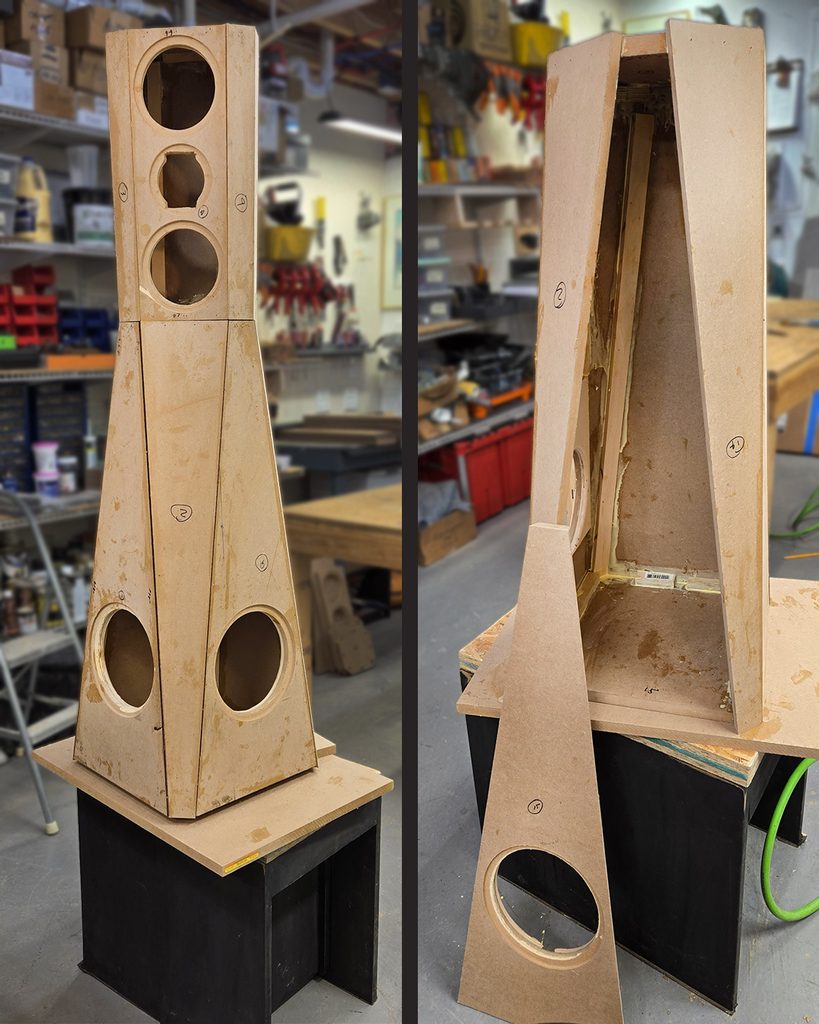
I started with sketches and developed my concept. Think of this creation as an MTM speaker on top of a separate woofer cabinet. The shape of the upper cabinet is an irregular octagonal cylinder.
The front panel of the upper MTM cabinet is tilted forward 2.7 degrees so that the sound waves are directed exactly to ear height from 10’ away. The circumference at the top is slightly wider than at the waist, so it has a Coke bottle vibe. Plus, the top is slanted towards the listener at 14 degrees to convey movement of sound from the speaker towards the listener.
The lower woofer cabinet is an irregular octagonal pyramid with a 4-degree slope. The vertical lines of the panels flow from the base up through the top of the cabinet. The woofers are mounted close to the floor and at a 45-degree angle right and left of center.
The cross section of the speaker is formed by three octagonal shapes. The top and a common center octagon define the upper cabinet. The common center and a bottom octagon define the lower cabinet. The 3 octagons have different dimensions and proportions. The largest side of lower cabinet has been rotated 45 degrees from the upper cabinet.
In order to complete the design and get detail component part drawings, I collaborated with a talented mechanical engineer with outstanding Solid Works CAD and 3D rendering skills to do 3D renderings.
Getting the proportions and slopes just right is an art. A small deviation makes or breaks the aesthetic appeal. I used the golden ratio (1.62:1) to get a beautiful design that flowed. The golden ratio theory is that forms with this ratio are perceived by the human brain as beautiful.
It took several iterations of 3D renderings to finally get a design that provided the aesthetic appeal I sought. Amazingly, the golden ratio works: the total height of 56” is 1.6 times 35” height of the woofer pyramid. The 16” min width of the base is 1.6 times the width of the 10” min width at the waist.
Enclosure Assembly: The final 3D rendering was then used to develop the flat individual piece part drawings. I created 9 templates to use to trace all the piece parts onto the ¾” thick MDF sheet. I cut the parts using my track saw. All cuts were compound angles. The parts were assembled with brads and glue. Thankfully, the CAD geometry was correct and the parts fit together perfectly the first time.
Bondo was applied at the seam between the upper and lower cabinets to get smooth curves. To get the rounded corners, I used high quality 3M breathing protection and went crazy with 60 grit sandpaper on a 5” rotary sander.
All corners have internal corner braces and the lower cabinet panel sections over 6” wide have horizontal stiffeners. The panels with drivers have an additional ½” thick Baltic Birch plywood panel on the inside to add stiffness and provide a strong material to secure the driver fasteners.
The inside of the panels was treated with a 2 mm thick adhesive-backed bituminous sheet typically used for automotive sound deadening. The panels pass the knuckle knock test with a solid thump.
Each speaker weighs 85 lbs and has 4 hidden leveling feet.
Very importantly, there is the color. I love this color. The high-end designs I mentioned offer a variety of colors to accentuate your listening space decor. I picked a famous blue color called IKB.
International Klein Blue is a deep blue hue first mixed by the French artist Yves Klein. Klein patented the formula for this intense ultramarine blue in 1960. This color became the artist’s signature, the hallmark of his practice, and it became instantly recognizable. For Klein, blue carried a “unique sensitivity and served as a vehicle for the passage from the material to the immaterial: Blue has no dimensions, it is beyond dimensions.” He says blue is spiritual.
You have seen this color before. International Klein Blue is the color of many corporate logos. It is the blue of the Blue Man Group. It was custom-mixed as Pantone 286 for me by Acry-Tech Coatings, the supplier of Dura-Tex.
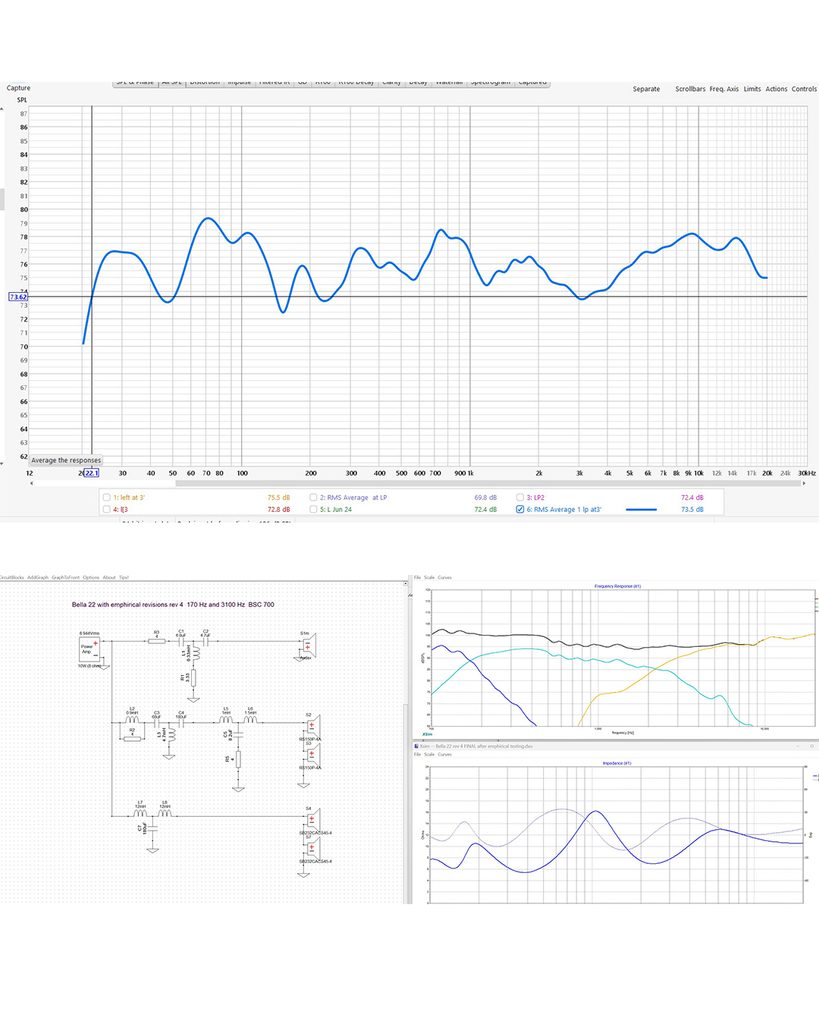
Crossover Design: I used XSIM to develop the crossover. This crossover design was the most challenging I ever designed. I knew that the woofer needed a low-pass frequency under 200 Hz to minimize directional beaming. Also, with woofers located so close to the floor, I expected a 6dB floor boost. Plus, the baffle step frequency for the 6.5” wide MTM section is 700 Hz. The mid gets the BSC circuit not the woofers.
It took several iterations to optimize the crossover. I found that Joe D’Appolito’s original recommendation to use a 3rd order filter worked best. From the bottom to the top, the woofers cross to the mids at 170 Hz. The woofer crossover design used the largest inductors I ever had in a crossover circuit. The woofer circuit uses two 12 mh inductors and a 180uF capacitor. The separate baffle step compensation circuit begins attenuating the mids at 700 Hz. The mids continue to do the heavy lifting until the tweeter takes over at 3100 Hz.
Finally, I set the mid and tweeter resistors for a very gently sloped Harman curve.
The upper cabinet uses poly-fill and the lower cabinet uses 1.5″ thick fiberglass insulation.
| Part # | Description |
| 295-563 | Dayton Audio RS150P-4A |
| Audax gold dome TW025A28 | |
| SB Acoustics SB23CACS45 ceramic coated 8” woofers |
“The design needs to be possible to build within the realm of DIY speaker builders. Templates are the key. All the parts are flat and were made with MDF. I cut them with my tack saw.”
This is a beautiful build. How did you come up with this concept?